ClassificationsAncient Near Eastern Art
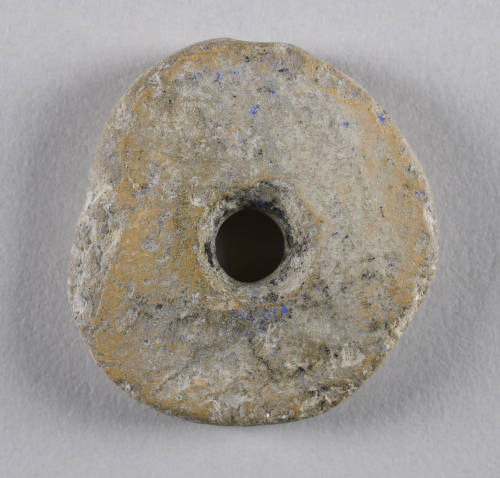
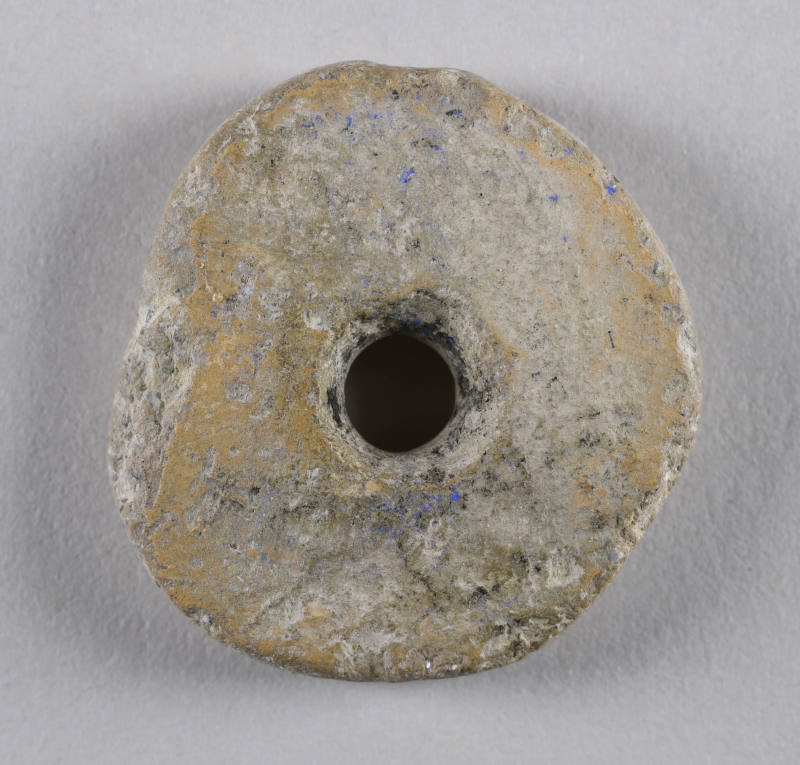
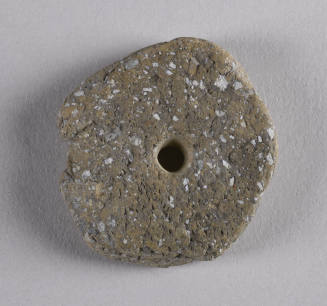
Spindle Whorl
Place ExcavatedJericho, Palestine, Asia
Date2300-2000 BCE
MediumStone
Credit LineJericho Excavations, 1952-1958
Dimensions3/8 x 1 7/16 in. (0.9 x 3.7 cm)
Object number1958.018
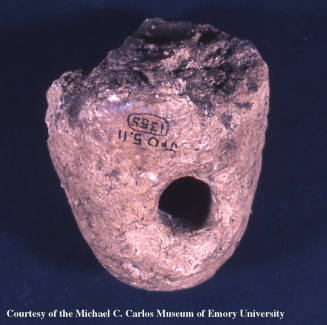
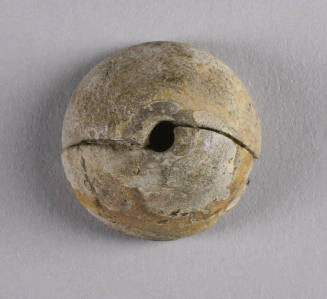
Label TextEvidence for the textile industry in ancient Jericho is recorded by badly preserved textile fragments and various tools and accessories which have survived. It is presumed that, at various times, the people of Jericho used plant fibers from palm trees, flax, and possibly animal hair fibers to weave and sew clothing. Draped robes and kilts made of a plain weave were attached by toggle pins and worn along with rarer tunics that were cut and sewn into shape. Analogies with the textile industry in Egypt suggest that the process of making textiles at Jericho probably consisted of three steps. Fibers were prepared by being soaked, beaten, and combed out or hackled. The fibers were then ready for spinning where they were then drawn on a spindle and twisted to produce yarn. As early as the Pottery Neolithic Period at Jericho (ca. 5500-4000 B.C.), wooden spindles weighted with a whorl made of wood or stone were commonly used. After spinning, the yarn was warped on the loom. Because very few loom weights have been found in the Bronze Age levels (1800-1550 B.C.), it is possible that a horizontal loom was used.
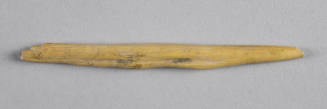
Little is known about the tools involved in the weaving process at Jericho except that they were used in other industries. Awls, for example, were likely to have been used to press down the weft in the course of the weaving when no comb was available, or to pick up threads of the weft to make designs.
Exhibition HistoryMCCM Permanent Collection Galleries, May 11, 1993 - Spring 2001
Published ReferencesKathleen Kenyon, Excavations at Jericho II (London: British School of Archaeology in Jerusalem, 1965), 107, figure 38.7.
ProvenanceExcavated by Kathleen Kenyon (1906-1978), Jericho, Palestine.
Status
Not on viewCollections
- Ancient Egyptian, Nubian, and Near Eastern Art
2000-1600 BCE
2300-2000 BCE
2000-1600 BCE
3300-2300 BCE
2300-2000 BCE
20th Century
20th Century
20th Century
800-600 BCE
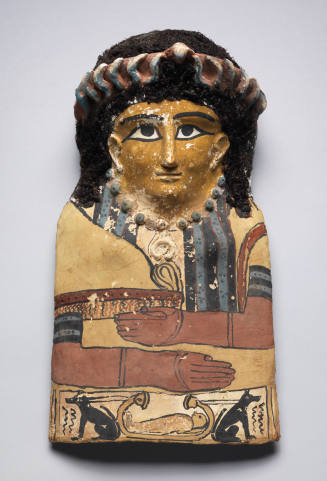
1st - 2nd century CE
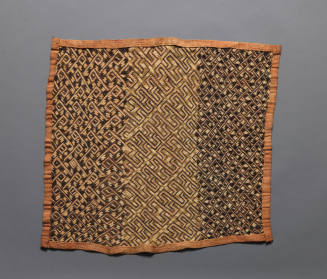
20th Century
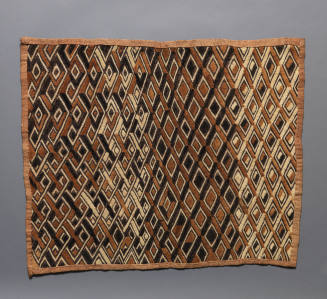
20th Century