ClassificationsWorks of Art on Paper
Artist
Hans Bellmer
(German, 1902 - 1975)
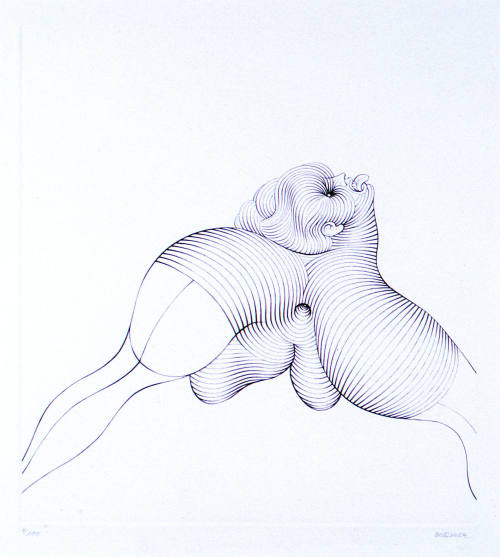
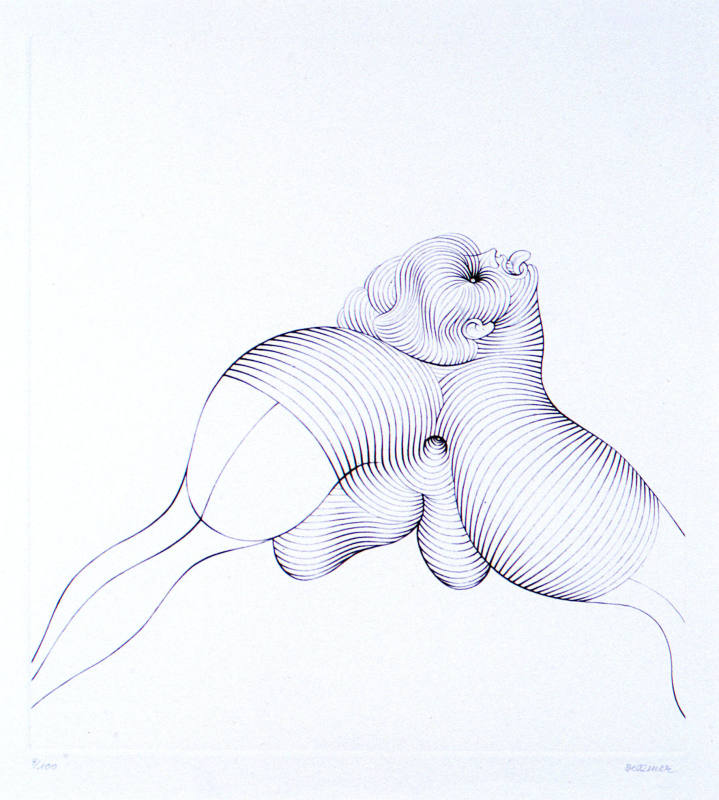
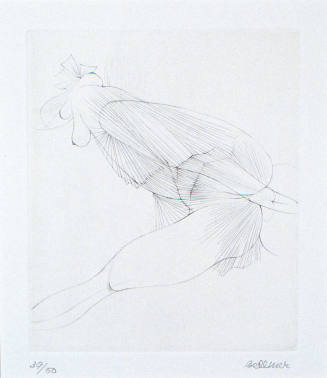
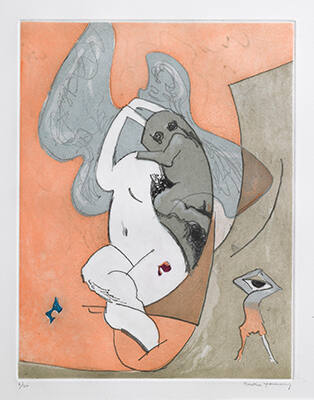
The Cephalopod (La Cephalopode)
Date1965
MediumEngraving
Credit LineGift of Robert S. Handler in memory of J. Allen and Lillian Handler
Dimensions9 5/8 x 8 3/4 in. (24.4 x 22.2 cm)
Object number1983.012.003
Label TextHans Bellmer came to the attention of the Surrealists in the mid-1930s through his photographs of The Doll, a life-sized female figure whose limbs could be disassembled and reassembled in as many bizarre combinations as the artist pleased. In his later drawings and prints, the keen precision with which Bellmer delineated and transposed the parts of the female body lends a plausibility to these images that engenders in the viewer an almost physical sense of shock. Bellmer, in a book published in 1957, explained his theory of the "anatomy of the image" and the origins of the metaphors and transforming devices which he employed in representing the body. Here he introduced the idea of the "physical unconscious" by describing how the body might respond to the twinge of a toothache with a reflexive clenching of the hand. The fist formed by the clenched hand can then be seen as an approximation of the form of a molar; in this way the tooth can be imaginatively superimposed upon a distant part of the body, the hand. This is the basic principle, the imaginative displacement of sensation from one body part to another, that underlies Bellmer's disquieting pictures. His reconfigurations and substitutions of body parts, however, are provoked not merely by pain, but rather by the intense erotic desire that exists between a man and a woman.Bellmer exposes the physical sensations of desire between two people through a variety of transforming mechanisms. One type of disarrangement derived from the artist's interest in the fetishistic detail, which he explained as the fixation upon a body part, such as a hand or a breast, not for itself alone, but for the complex associations which desire projects upon it. For Bellmer such a detail became a concentrated image evoking the whole of the desired woman. The female body of The Cephalopod is an image deformed and reformed through a series of operations that Bellmer thought of as mathematical permutations. The torso is subtracted; buttocks and breasts divide and multiply. The cephalopod, a creature like the octopus or the squid, composed only of head and legs, constantly changing shape as it moves through the water, was a fascinating metaphor for Bellmer. For Bellmer, these images of anatomical dislocation represented a "third reality," the product of a dialectical confrontation between the body and the imagination.
Exhibition HistorySurreal Anatomies, Michael C. Carlos Museum, October 7, 2000 - January 28, 2001
ProvenanceEx coll. Robert S. Handler (1937-2015), Atlanta, Georgia.
Status
Not on viewCollections
- Works of Art on Paper
ca. 6th-7th Century CE
2nd Century BCE
ca. 2500-2400 BCE

664-589 BCE
18th-19th Century