ClassificationsAfrican Art
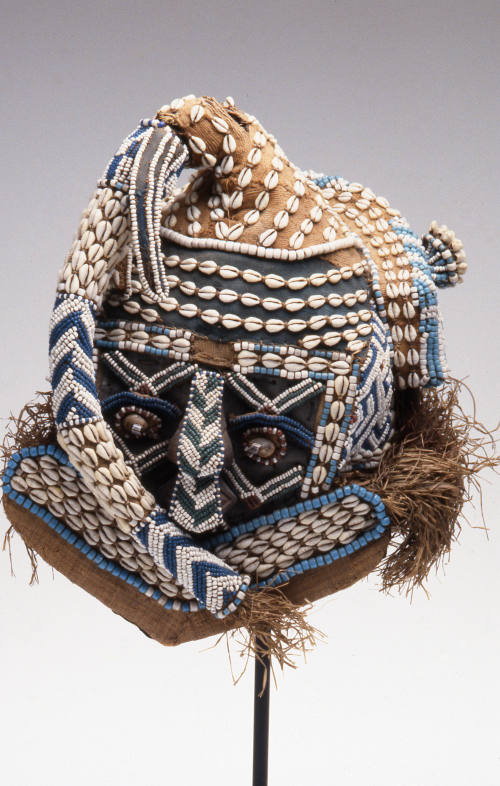
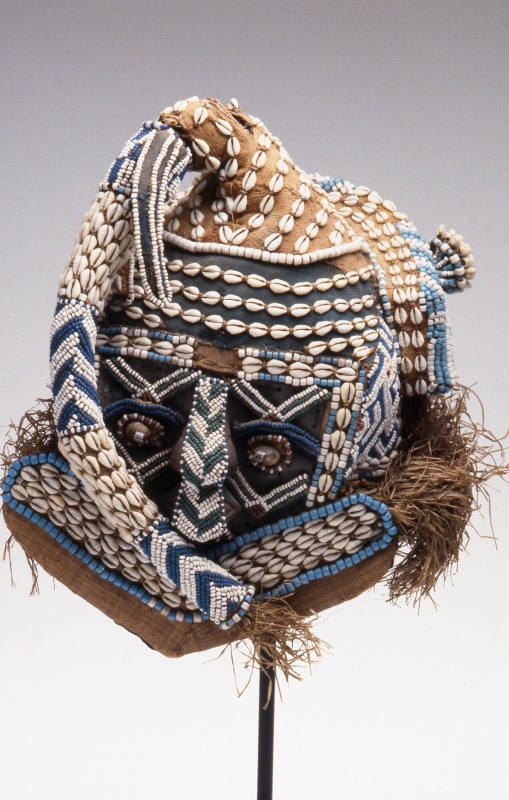
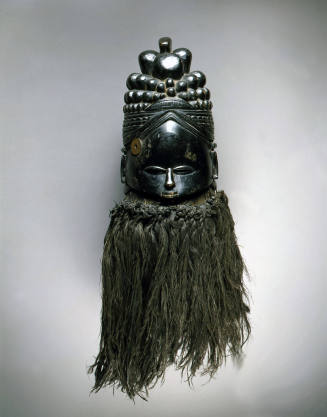
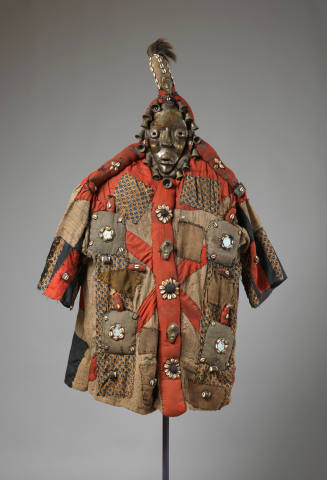
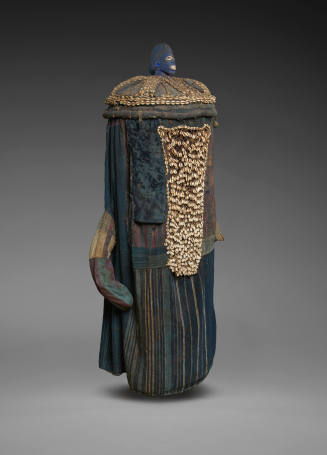
Mwaasham Boy Mask
Place CreatedDemocratic Republic of the Congo, Africa
CultureKuba
Date20th Century
Credit LineEx coll. William S. Arnett
Dimensions16 15/16 x 14 9/16 x 12 5/8 in. (43 x 37 x 32 cm)
Object number1994.004.190
Label TextThe Kuba, a confederation of ethnic groups under the authority of the king of the Bushong, have masking traditions that allude to both royalty and mythology. Oral history recounts that this type of spectacular beaded mask, known as Mwash a Mbooy, was first introduced during the reign of Bo Kena, the seventy-third king of the Kuba (ca. 1400). The mask is linked to Bushong royal power for it represents Woot, original ancestor, hero, and founder of the Kuba kingdom, who was also believed to have introduced the arts of weaving, agriculture and iron working. Mwash a Mbooy appears with two other kinds of masks during male puberty initiation rites and during the funeral ceremony of a king, when his successor assumes the power of Woot, thereby symbolizing the continuity of the royal line. The helmet mask is constructed on a rattan frame covered by cloth and beads. The flat squarish face of the mask is rigid, having been lined with a strip of metal. The nose, mouth, and ears are made of wood and attached to the frame. Below the face, rows of cowrie shells form a broad collar. A similiar cowrie band behind the head becomes an elaborate coiffure. This rich decoration of cowries and beads indicate the wearer's high social status and wealth. A trunk-like appendage to the top of the mask, which is whipped back and forth during a perfomance, metaphorically equates the power of the king with that of an elephant.Exhibition HistoryThe Art of Collecting: Recent Acquisitions at the Michael C. Carlos Museum, Michael C. Carlos Museum, November 8, 1997 - January 4, 1998
ProvenanceEx coll. William S. Arnett (1939-2020), Atlanta, Georgia.
Status
Not on viewCollections
- African Art
late 19th-mid 20th Century
19th Century
20th Century
late 19th-early 20th Century
late 19th-late 20th Century
19th-20th Century
305-30 BCE
305-30 BCE
late 19th-early 20th Century
1930s
late 19th-late 20th Century
Parallel Number 1/Parallel Number 2